
Toxic vapor detection before and during crew entry
Chemical detection campaigns for refineries, chemical and petrochemical plants, using a military-grade handheld detector, a record of every reading, and fixed points linked to plant supervision.

What routine clearance does not always catch
In process plants, chemical risk changes with every equipment opening, purge, or drain. Measurement has to follow the work, and it has to be recorded.
Process toxics outside the multigas
A routine multigas detector measures oxygen, flammability (LEL), H₂S, and CO. Other plant products need specific detection, which is not always available at the work front.
Conditions that change mid-task
Opening flanges, removing sludge, and draining lines release vapors after the area has been cleared. A single reading at the start of the shift does not follow those changes.
Paper records that are hard to audit
Without location, time, and person on every reading, it is hard to prove clearance during audits, incident investigations, and work permit reviews.
Where chemical detection fits into plant routines
The same device works handheld, body-worn, vehicle-mounted, or installed as a fixed point. Each application is planned around the products present in the plant.
Pre-entry inspection
Tanks, vessels, columns, galleries, and pits before the work permit is signed.
What OPTIKON deliversSweep of openings and surroundings, with a reading logged per point and the result attached to the permit.
Operating mode- Handheld
Turnarounds and maintenance works
Work fronts during planned shutdowns and equipment assembly or disassembly.
What OPTIKON deliversPlanning and follow-up of detection campaigns for defined products, logging location, time, and events.
Operating mode- Body-worn
- Fixed point
Fixed points in process areas
Tank farms, pump houses, loading and unloading bays, and unit boundaries.
What OPTIKON deliversSpecification and installation, with a specialist partner, of detectors connected to plant supervision.
Operating mode- Fixed point
- Control room
Leak response support
Fire brigades and emergency teams during leaks and accidental releases.
What OPTIKON deliversEquipment and a specialist team to screen for substances in the library and help set isolation zones.
Operating mode- Handheld
- Vehicle-mounted
Screening of suspect residues and cargo
Mining, logistics yards, and incoming materials.
What OPTIKON deliversTargeted search for explosive traces and other substances covered by the purchased configuration, using surface swabs.
Operating mode- Trace swab
One more check before entry is cleared
The toxic sweep slots into the clearance flow the plant already uses: after oxygen and flammability readings, before the work permit is signed. The decision to clear entry stays with plant leadership.
- 1
Permit request
PlantArea, task, and products that may be present in the equipment.
- 2
Isolation and purge
PlantLine blocking, blinding, draining, washing, and ventilation.
- 3
Multigas reading
PlantOxygen, flammability (LEL), H₂S, and CO, per plant procedure.
- 4
Toxic sweep
ExxataReading of the products defined in the plan, at openings and around the equipment.
- 5
Record and decision
Exxata + plantReading attached to the permit. Entry is cleared or sent back for another purge.
- 6
Monitoring during the task
ExxataBody-worn detector or fixed point at the entrance while anyone is inside.
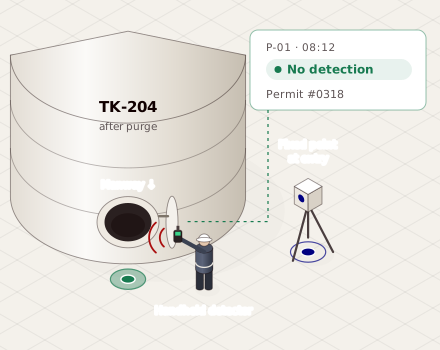
Complements, and does not replace, the confined space entry procedure under Brazilian NR-33 and the NR-20 controls for flammables and fuels.
From the plant product list to the campaign report
Before taking the device to the field, we confirm what it can detect at that plant. That defines the points, operating modes, and alarm criteria.
- STEP 01
Substance assessment
We cross-check the product inventory and safety data sheets (SDS) against the detector library to confirm what will be covered.
- STEP 02
Campaign plan
Point map, reading frequency, operating mode for each area, and alarm criteria agreed with plant HSE.
- STEP 03
Field execution
OPTIKON crew on site or trained plant operators, with the device checked as specified by the manufacturer.
- STEP 04
Record and report
Every reading with location, time, person, and result. Campaign report with events and actions taken.
| Time | Point | Mode | Reading | Status |
|---|---|---|---|---|
| 07:52 | TK-204 · manway | Handheld | No detection | Cleared |
| 08:12 | TK-204 · entry | Body-worn | No detection | Under monitoring |
| 09:40 | PH-12 · pump house | Fixed point | Alarm | Area isolated |
| 10:15 | PH-12 · pump house | Handheld | No detection | Cleared after recheck |
Alarms that reach the people who decide
At fixed points, the detector can run on mains or vehicle power and send its alarm to the control room. In the field, alerts can be mirrored to a supervisor over a wireless link.
- HandheldSpot sweeps and rechecks.
- Body-wornPersonal alarm during the task.
- Fixed pointContinuous detection at entrances and critical areas.
- Vehicle-mountedMoving between units and responding.
- Remote alarm contactsDirect signal to a siren, panel, or PLC.
- RS-232 · RS-422 · USBDetection data for external systems.
- WirelessDetector network linked to operations command.
- Control roomAlarm integrated into plant supervision.
- Remote supervisorMirrored audio and visual alerts, with substance identity and level.
- Campaign reportHistory of readings and events.
Pairing with OPTIKON cameras
At the entrance to monitored areas, cameras with virtual fences and people counting record who went in, when, and how many are still inside.
Ion mobility spectrometry (IMS) chemical detector
A technology with a track record in defense, aviation, and OPCW-accredited laboratories. It detects and identifies gases and vapors of toxic industrial chemicals (TICs) and chemical agents, reporting class, concentration, and cumulative dose.
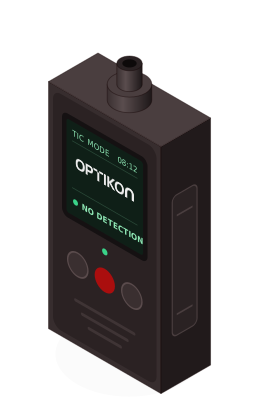
Specifications
- Technology
- Ion mobility spectrometry (IMS)
- Detection
- Gases and vapors at or below IDLH levels
- Output
- Identity, class, concentration, and cumulative dose
- Start-up
- Under 90 seconds
- Battery life
- Up to 96 h on standard AA batteries
- Memory
- At least 72 h of detection data
- Operating temperature
- −32 °C to +52 °C
- Ruggedness
- MIL-STD-810G
- Interfaces
- RS-232, RS-422, USB, and remote alarm contacts
- External power
- 8–32 V (vehicle) and 110–240 V (mains)
Optional trace adapter
Swab collection of solid and liquid residues on surfaces. The sample is heated and analyzed by the detector itself, for explosives and other substances in the configuration.
Detection scope
- Substances included in the library configured on the device
- Airborne gases and vapors, at or below IDLH levels
- Surface traces, with the optional adapter
- Oxygen and flammability (LEL) readings from the plant multigas
- Quantitative occupational exposure assessment with sampling and lab analysis
- The work permit procedure and NR-33 and NR-20 requirements
Frequently asked questions about chemical monitoring
Does the detector replace the multigas used for confined space clearance?
No. The multigas remains responsible for the oxygen, flammability (LEL), H₂S, and CO readings required by the NR-33 procedure. The IMS detector adds readings for process-specific toxics that the multigas does not measure.
Which substances can be detected?
Those included in the library configured on the device. Before any campaign, we cross-check the plant product inventory and SDS against that library and state in writing what will and will not be covered.
Can the device be used in hazardous (classified) areas?
It depends on the explosive atmosphere (Ex) certification of the configuration in use. We check this during the assessment, together with the plant hazardous area rules, before defining where each operating mode can be used.
Does OPTIKON operate the device or train plant staff?
Both are possible. For turnarounds and short campaigns, the OPTIKON crew can operate on site. For continuous monitoring, plant technicians and operators can be trained to operate it, with OPTIKON following up on the records.
Can alarms reach the control room?
Yes, at fixed points. The device provides remote alarm contacts and RS-232, RS-422, and USB outputs. Integration with plant supervision is specified and installed with a specialist partner.
How are the records made available?
Every reading is logged with point, time, person, operating mode, and result. At the end of the campaign, the plant receives a report with events and actions taken, which can be attached to permit documentation and incident investigations.
Schedule a complimentary operational assessment
Connect our engineering team with plant HSE. We map the products present, the areas, and the operating modes to build the campaign plan.
Request Proposal & Technical Pilot
Fill in your company details to receive a technical response within 2 business hours.
OPTIKON ECOSYSTEM
Explore Related Solutions & Sectors
People Management & Safety
Real-time PPE compliance, unsafe acts mitigation, and crew productivity.
Stockyard Management
Continuous stockpile volume cubing and conveyor telemetry without scales.
Administration & Security
Spatial intelligence, CCTV facial recognition, and license plate recognition.